Monday, 28 October 2019

Saturn receiving water from one of its moons, ESA spacecraft finds

The planet's upper atmosphere is marked by the presence of water. But where it comes from has been a mystery until now. The ESA's Herschel spacecraft has identified water shooting from jets on Saturn's Enceladus moon.
The European Space Agency's (ESA) Herschel spacecraft has identified the source of a water vapor ring surrounding Saturn. One of Saturn's moons - Enceladus - spews 250 kilograms (550 pounds) of water vapor into space every second. The announcement was published Tuesday on the ESA's website

Anywhere from three to five percent of that water ends up falling onto the planet itself, influencing the chemical composition of its atmosphere. No other moon in the solar system is known to do so. The water expelled from Enceladus mostly erupts from jets in an area of the moon's south pole known as the "Tiger Strips" for their distinctive markings.

  Paul Hartogh, of the Lower Saxony-based Max Planck Institute for Solar System Research, led the analysis of data gathered by Herschel and told Deutsche Welle the water emitted by Enceladus is "enough to explain the amount of water first discovered in Saturn's atmosphere" in 1997.
The reason why so much water is produced is not clear," he said. "Of course you have this warm area in the south - and that is probably created by some tidal forces - but the exact mechanism is not know. The amount of energy dissipating due to tidal forces is actually not enough to explain why so much water is produced there.

Water for life

According to Tilman Spohn, of the German Aerospace Center's Institute of Planetary Research in Berlin, the discovery is a puzzling one which gives rise to more questions than it answers. Enceladus' eruptions are surprising for a body of its size, he said. A general assumption is that the larger a body in space is, the more unstable and active it becomes.

  This thing is (actually) too small to generate volcanic activity and generate heat," Spohn told Deutsche Welle. "There is much more heat output than you would expect for a body like that."

Yet beyond Enceladus' inexplicable qualities, the moon has caught scientists' interest in part because the presence of liquid water is a prerequisite for life as we know it.

"There is speculation about Enceladus being habitable for microbial life forms - nobody has discovered anything like that yet, but it is a body of particular interest in terms of life outside the earth," Spohn said.

Compared with Earth

Walter Schmidt, a specialist on planets and comets at the Finnish Meteorological Institute of Helsinki, says Enceladus seems to be covered by an ice cap with water underneath.
An early explanation for the eruption of water could be Saturn's gravitational pull on its moon, he said. Other moons of Saturn also have eruptions, although they spew materials other than water into space.

Because of the low pressure in space, the water coming from Enceladus becomes a vapor can't remain in its liquid form or freeze, which is why it becomes vapor, according to Schmidt. The water vapor is then broken down into hydrogen and oxygen by UV light and collisions with solar wind particles. That "basically ensures that water molecules are not stable in space," he added.

Schmidt says studying the conditions on Saturn and Enceladus can help scientists to "understand what makes Earth so special" in its ability to sustain life and explain "how water came here to Earth in the first place."

The spectroscopic capabilities of Herschel allow the spacecraft to distinguish between water, oxygen and hydrogen, Schmidt added.

"Water has a very characteristic spectral distribution and can be detected rather easily," he said. "Once it disassociates these spectral properties are gone, one has to look separately for oxygen lines and hydrogen lines."

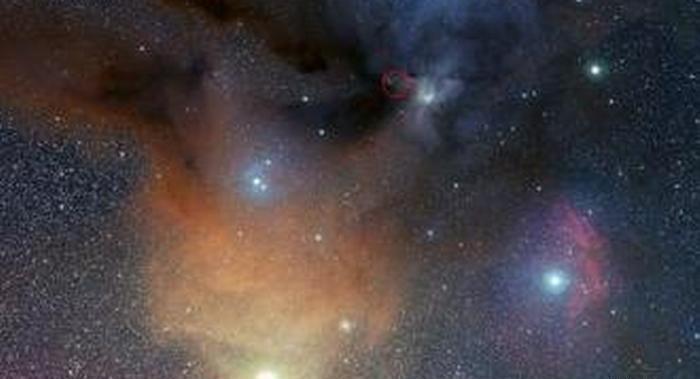
ESA spacecraft finds first oxygen gas molecules in space

Scientists have detected oxygen molecules in the star-forming region of Orion. Researchers believe frozen dust particles consisting of oxygen atoms evaporated in the heat of budding stars to form molecules.
In a new scientific paper published on Monday, the European Space Agency's (ESA) Herschel spacecraft has discovered oxygen molecules in space. The findings were published in the August 1 edition of Astrophysical Journal.

While oxygen in its atomic form exists in water and carbon monoxide - and according to researchers is therefore the third most abundant element in the universe - ESA's Herschel mission has discovered the first molecular instance of oxygen space. That is, two oxygen atoms bound together to form the dioxygen (O2) molecule.

 The oxygen molecules were discovered in the Orion star-forming region. However, they are few in number. The scientists used three infrared frequencies emitted by Herschel's far-infrared instrument and found one oxygen molecule for every million hydrogen molecules within gas and dust surrounding Orion's forming stars.

 The scientists had decided to search Orion based on the theory that heat from the constellation's forming stars would evaporate ice from tiny dust grains to form oxygen molecules.

  The largest single mirror ever built for a space telescope is aboard the Herschel spacecraft, which collects "long-wavelength radiation from some of the coldest and most distant objects in the universe," according to the ESA.
Hiding' oxygen According to Göran Pilbratt, a Netherlands-based ESA scientist on the Herschel project, the scientists hope to find out where else in space oxygen molecules may have formed. "
It will certainly be of considerable interest to establish abundances of O2 in different environments to be able to understand what is going on," he told Deutsche Welle in an e-mail. "Obviously non-stationary processes must be at play.

We already now know for a fact a lot of the oxygen must exist in other forms than O2." Pilbratt added that scientists long suspected oxygen molecules exist in space, but have been baffled by their inability to find them. NASA's Submillimeter Wave Astronomy Satellite and Sweden's Odin mission have both searched so far, without any results

Stationary chemical models indicate that a lot of the oxygen in the interstellar medium ought to exist in the form of O2, but previous searches showed this not to be the case, providing upper limits two orders of magnitude lower than the expected abundances," he said

Other space scientists have been encouraged by this result. Bérengère Parise, a French researcher based at the Max Planck Institute in Bonn, whose team last month revealed the presence of hydrogen peroxide in space, said that this new finding is a positive step.

"This discovery will allow astrochemists to refine their models and better understand the chemical interplays between gas and dust particles in interstellar clouds, as well as to understand how much material is frozen out onto the surface of cold dust particles," she wrote in an e-mail sent to Deutsche Welle.

A measured abundance is always much more constraining for models than an upper limit based on non-detections (as was available in the past)," she added. "Star formation theories will also have to take into account the observed abundance of oxygen in the computation of the cooling rates."

NASA's California-based Paul Goldsmith, one of leaders of the international team of investigators, said finding the oxygen molecules opens the door to further questions. "We didn't find large amounts of (oxygen molecules), and still don't understand what is so special about the spots where we find it," he said in a statement. "The Universe still holds many secrets."  

Venus has ozone layer, ESA scientists say

The solar system's second planet's newfound ozone may help to understand other planets. Scientists are hoping for more missions to confirm the presence of simple life on the harsh, turbulent planet.
On Thursday, the European Space Agency (ESA) announced that its Venus Express spacecraft had discovered that Venus, the second-closest planet to the Sun, has an ozone layer.
Scientists say that ozone on a planet may indicate the presence of life.

The ozone found on Venus is at far too small of a concentration to indicate that it derived from life there. But comparisons with ozone levels on Earth could help set parameters to determine the likelihood of life elsewhere

By chance
Scientists from ESA made the determination after analyzing measurements from instruments aboard the Venus Express craft.

"We have been able to identify the signature [of the gas]," Franck Montmessin, an ESA researcher, told Deutsche Welle.

On-board instruments measured changes in wavelength of starlight passing through Venus' rather thick atmosphere.

"It was a bit by chance," Montmessin said. "We carefully looked at the spectra, and we saw some unexpected features," he explained.

The finding built on discovery of ozone on Mars, which "was more obvious," Montmessin added.

Other scientists were excited by these findings.

Anja Bauermeister, an astrobiologist at the German Aerospace Center, who was not part of the new ESA findings, told Deutsche Welle that she thinks the data are trustworthy, in particular since the measurements were taken so close to the planet
As for life - possibly microbial - on Venus, Bauermeister said, "There is speculation."

These tiny, simple forms of life could have occurred shortly after the planet was formed, and if so, then most likely in drops of water in clouds of the upper atmospheric layers.

But the greenhouse effect on Venus, due in part to its lacking a thick ozone layer, has effectively prevented it from being hospitable to life.

"Conditions on Venus are really too harsh - people say it's basically like hell: hot, acidic," Montmessin said.

Ozone on Venus is nowhere near levels indicating that it originated from life. Rather, the Venusian ozone layer is likely a result of sunlight breaking up carbon dioxide in the planet's atmosphere.

Biosignatures


Ozone may, however, act as a "biosignature" - an element indicating the presence of life. "If we find ozone on an exoplanet, we can't just jump for joy and say 'yoo-hoo! We've found life!'," Bauermeister said.

 Exobiologists and astronomers say that the presence of ozone, especially in combination with oxygen and carbon dioxide, is a decent indicator of a higher probability that life may exist on a planet. Bauermeister noted that methane, together with oxygen, is also a good biosignature.

But the best one, she explained, is nitrous oxide, since it's a direct byproduct of life. However, nitrous oxide is extremely difficult to measure in light spectrums, she added

  Further probes


Montmessin said the ozone signatures were found quite high in the atmosphere, at about 100 kilometers from the surface of the planet. The ability for the Venus Express to probe the Venus atmosphere is limited, due to a thick layer of sulphuric acid. "One could send balloons into the Venusian atmosphere" to probe it further,

Montmessin said, adding that this has been done in the past. In any case, he said, "we need to go back to Venus and use other types of measurements to see if there are types of complex organisms there." Author: Sonya Angelica Diehn Editor: Cyrus Farivar